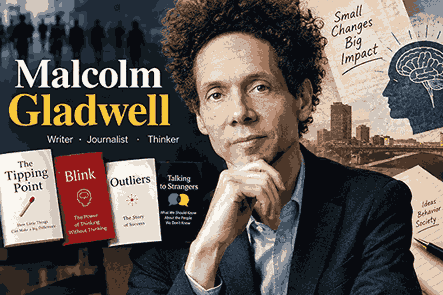
Malcolm Gladwell: The Complete Guide to His Books, Ideas, and Lasting Impact
You’ve heard the name. You’ve seen the books on every airport shelf. But do you actually know what Malcolm Gladwell changed about the way millions of people think? Most readers grab one bestseller and stop there. That means you miss the bigger picture. This guide breaks down every major work, idea, and controversy so you finally understand why Malcolm Gladwell reshaped modern nonfiction.
Who Is Malcolm Gladwell and Why Does He Matter?
Malcolm Gladwell is a Canadian-born journalist, author, and podcast host who has spent over three decades turning complex social science into gripping stories. He joined The New Yorker as a staff writer in 1996 and quickly became one of the magazine’s most recognizable voices.
His talent lies in connecting dots that most people never notice. He takes research from psychology, sociology, and economics and wraps it in narratives that feel like thrillers. That skill turned him into a household name and a dominant force in narrative nonfiction.
What Books Has Malcolm Gladwell Written?
Malcolm Gladwell has published seven major books, each tackling a different slice of human behavior. Every title landed on The New York Times bestseller list and sparked widespread public debate.
Here is a complete breakdown of his published works:
| Book Title | Year | Core Topic | Key Concept | Copies Sold (Approx.) |
| The Tipping Point | 2000 | Social epidemics | The Law of the Few | 5+ million |
| Blink | 2005 | Rapid cognition | Thin-slicing | 4+ million |
| Outliers | 2008 | Success patterns | 10,000-Hour Rule | 6+ million |
| What the Dog Saw | 2009 | Curiosity-driven essays | Hidden patterns | 2+ million |
| David and Goliath | 2013 | Underdog advantages | Desirable difficulties | 3+ million |
| Talking to Strangers | 2019 | Miscommunication | Default to truth | 3+ million |
| The Bomber Mafia | 2021 | WWII strategy | Moral trade-offs | 1+ million |
Each book follows a similar formula: start with a surprising anecdote, introduce academic research, and build toward a counterintuitive conclusion. Readers love this structure because it makes dense ideas feel effortless.
What Is The Tipping Point About?
The Tipping Point launched Malcolm Gladwell into superstardom. The book argues that ideas, products, and behaviors spread like viruses. Small changes can trigger massive social shifts once they cross a critical threshold.
He introduces three types of people who drive these epidemics:
- Connectors: People with enormous social networks who link different groups together.
- Mavens: Information specialists who accumulate knowledge and share it freely.
- Salesmen: Persuasive communicators who convince others to adopt new ideas.
This framework gave marketers, educators, and public health officials a new vocabulary for understanding how change actually happens. The book remains one of the most cited works in social psychology and behavioral science.
How Did Blink Change the Way We Think About Decisions?
Blink explores the power and danger of snap judgments. Malcolm Gladwell argues that your brain can process enormous amounts of information in the blink of an eye, often arriving at conclusions that rival careful analysis.
He calls this process “thin-slicing.” Your unconscious mind grabs a narrow slice of experience and extracts meaning from it almost instantly. A seasoned art expert can spot a forgery in seconds. A marriage counselor can predict divorce from a brief conversation.
But thin-slicing also fails spectacularly. Bias, stress, and lack of expertise can corrupt rapid cognition. The book forces readers to ask a hard question: when should you trust your gut, and when should you slow down?
What Makes Outliers One of the Most Discussed Books of the Century?
Outliers shifted the global conversation about success. Malcolm Gladwell dismantles the myth of the self-made individual and replaces it with a more nuanced story. Talent matters, but timing, culture, geography, and hidden advantages matter just as much.
He highlights several striking examples:
- Canadian hockey players born in January dominate elite leagues because of age-cutoff rules.
- Bill Gates had rare access to a computer terminal as a teenager, giving him thousands of hours of practice before most people even touched a keyboard.
- Korean Air’s crash record improved dramatically after the airline addressed cultural communication barriers in the cockpit.
The book challenges readers to rethink how they measure achievement and who deserves credit for it.
What Did Malcolm Gladwell Reveal in David and Goliath?
David and Goliath flips the classic underdog story on its head. Malcolm Gladwell argues that perceived disadvantages often hide powerful strengths, while obvious advantages can become crippling weaknesses.
He introduces the concept of “desirable difficulties.” Dyslexia, for example, forced many successful entrepreneurs to develop superior listening and delegation skills early in life. Losing a parent in childhood, while devastating, built resilience in a surprising number of world leaders.
The book pushes back against the assumption that bigger, richer, and stronger always wins. It asks readers to look at their own obstacles with fresh eyes.
Why Did Malcolm Gladwell Write Talking to Strangers?
Talking to Strangers examines why humans misread people they don’t know. Malcolm Gladwell uses real cases — from the Bernie Madoff scandal to the arrest of Sandra Bland — to show how our default assumptions about honesty and transparency lead us astray.
He draws on the work of psychologist Tim Levine and his “Truth-Default Theory.” Most people assume others are telling the truth until overwhelming evidence proves otherwise. That instinct keeps society functioning but also makes us vulnerable to deception.
The book hit shelves in 2019 and immediately reignited debates about policing, diplomacy, and interpersonal trust. It remains one of his most emotionally charged works.
What Is the 10,000-Hour Rule and Is It Actually Accurate?
The 10,000-hour rule comes from Outliers and quickly became one of the most repeated ideas in popular culture. Malcolm Gladwell popularized research by psychologist K. Anders Ericsson, suggesting that roughly 10,000 hours of deliberate practice separates world-class performers from everyone else.
However, Ericsson himself pushed back on the simplified version. The original research emphasized deliberate practice — focused, coached, and constantly corrected effort — not just any repetition. Logging 10,000 hours of casual guitar strumming will not make you Jimi Hendrix.
The idea still holds value as a reminder that mastery requires serious commitment. Just don’t treat the number as a magic threshold.
How Does the Revisionist History Podcast Work?
Revisionist History is a podcast produced by Pushkin Industries, the audio company Malcolm Gladwell co-founded in 2018. Each episode re-examines an overlooked event, person, or idea from the past and asks whether we got the story right the first time.
The show covers topics ranging from the true origins of the SAT to the hidden genius of forgotten country music artists. It regularly ranks among the top podcasts on Apple and Spotify.
The podcast format gives him room to explore ideas that don’t fit neatly into a book chapter. Listeners get the same storytelling craft with more spontaneity and humor.
What Writing Techniques Make His Work So Addictive?
Several specific techniques set his writing apart from typical nonfiction:
- Cold opens: Every chapter begins with a vivid scene that drops the reader into the middle of a story.
- Juxtaposition: He places two seemingly unrelated stories side by side and reveals a hidden connection.
- Conversational tone: He writes the way he speaks, using short sentences and direct address.
- Cliffhanger transitions: Each section ends with an unanswered question that pulls you into the next.
- Data as narrative: Statistics never appear in isolation. They always serve a character or a plot.
These techniques explain why readers who normally avoid nonfiction find themselves finishing his books in a single weekend.
What Are the Biggest Criticisms of His Work?
No public intellectual escapes scrutiny, and Malcolm Gladwell faces his share. Academic researchers sometimes argue that he oversimplifies complex studies to fit a neat narrative. A single study becomes a universal law, and nuance gets trimmed for readability.
Critics like psychologist Steven Pinker have pointed out that anecdotal storytelling can create the illusion of causation where only correlation exists. The 10,000-hour rule drew particular fire for flattening Ericsson’s more careful findings.
These criticisms are worth taking seriously. They remind readers to treat his books as starting points for curiosity, not as final verdicts on scientific truth.
Where Should You Start Reading His Work Today?
If you have never picked up one of his books, start with The Tipping Point. It lays the foundation for his storytelling style and introduces the big ideas that echo through every later work.
After that, move to Outliers for the most culturally impactful arguments, then Blink for the most personally applicable insights. Talking to Strangers works well as a standalone entry if you prefer true-crime-adjacent narratives.
You can also listen to Revisionist History on any major podcast platform for free. It offers the fastest way to experience his thinking without committing to a full book.
Frequently Asked Questions
What is Malcolm Gladwell’s most famous book?
The Tipping Point is his most famous and influential book. It introduced concepts like the Law of the Few and the Stickiness Factor to mainstream audiences and has sold over five million copies worldwide.
Is Malcolm Gladwell a journalist or an author?
He is both. He has worked as a staff writer for The New Yorker since 1996 and has published seven bestselling books. His journalism and book writing feed into each other constantly.
What is the 10,000-hour rule from Outliers?
The 10,000-hour rule suggests that achieving world-class expertise in any field requires roughly 10,000 hours of deliberate practice. The concept originated from research by K. Anders Ericsson and was popularized by Gladwell in Outliers.
Does Malcolm Gladwell have a podcast?
Yes. He hosts Revisionist History, a podcast produced by his company Pushkin Industries. The show re-examines overlooked moments from the past and consistently ranks among the top podcasts globally.
Where was Malcolm Gladwell born?
He was born in Fareham, Hampshire, England, on September 3, 1963. He grew up in Elmira, Ontario, Canada, and holds Canadian citizenship.
How many books has Malcolm Gladwell written?
He has written seven books: The Tipping Point, Blink, Outliers, What the Dog Saw, David and Goliath, Talking to Strangers, and The Bomber Mafia.