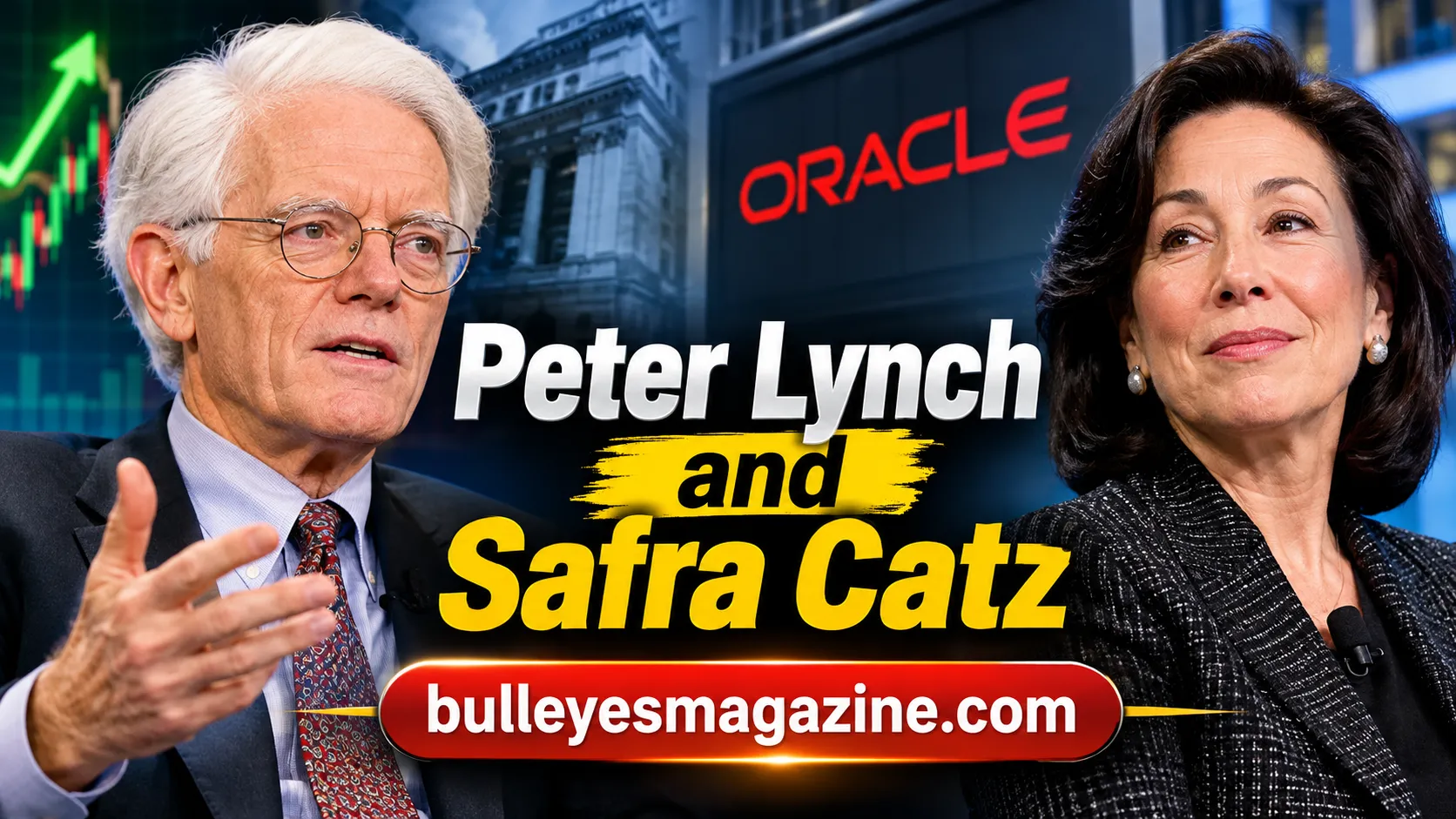
Peter Lynch and Safra Catz: Two Titans Who Redefined Finance and Corporate Leadership
Most investors and professionals study a single financial leader and miss the bigger picture entirely. That narrow focus leaves costly blind spots in your strategy and career planning. Examining Peter Lynch and Safra Catz side by side reveals timeless leadership and investment principles that sharpen your decisions across any industry, market cycle, or career stage.
Who Are Peter Lynch and Safra Catz?
Peter Lynch and Safra Catz represent two distinct paths to the top of American business. Lynch became the most celebrated mutual fund manager in history through his work at Fidelity Investments. Catz climbed the corporate ladder in investment banking before taking the helm at Oracle Corporation.
Both started with modest beginnings. Both faced personal hardships early in life. Both turned those challenges into fuel for extraordinary careers that reshaped their respective industries.
Lynch proved that everyday people can beat Wall Street professionals at stock picking. Catz proved that disciplined acquisition strategy and operational precision can transform a software company into a cloud computing powerhouse.
Peter Lynch: From Boston Childhood to Wall Street Icon
Peter Lynch was born on January 19, 1944, in Newton, Massachusetts. His father died of cancer when Peter was just ten years old. That loss forced the young Lynch to grow up fast and find ways to support his family.
He caddied at Brae Burn Country Club in Wellesley, Massachusetts. That job introduced him to the world of finance. He overheard wealthy golfers discussing stocks and investments on the fairways. Those conversations planted the seeds for his legendary Peter Lynch investment strategy.
Lynch earned his bachelor’s degree from Boston College in 1965. He then completed his MBA at the Wharton School of the University of Pennsylvania in 1967. He joined Fidelity Investments as an intern in 1966 and accepted a full-time position as a research analyst in 1969.
By 1977, Fidelity handed him the keys to the Fidelity Magellan Fund. The fund held roughly $18 million in assets at the time. Over the next thirteen years, Lynch grew it to over $14 billion. His average annual return of 29.2% remains one of the greatest track records in mutual fund history.
Safra Catz: From Israel to the Top of Oracle
Safra Catz was born on December 1, 1961, in Holon, Israel. Her family relocated to Brookline, Massachusetts, when she was six years old. Growing up as an immigrant in New England shaped her fierce work ethic and competitive drive.
She graduated from the University of Pennsylvania in 1982 with a bachelor’s degree. She then earned her Juris Doctor from Harvard Law School in 1986. Catz launched her career at the investment bank Donaldson, Lufkin & Jenrette (DLJ), where she spent eleven years rising to the position of managing director.
In 1999, Larry Ellison recruited her to join Oracle. She started as senior vice president and quickly moved through the executive ranks. She became president in 2004, co-CEO alongside Mark Hurd in 2014, and sole Safra Catz Oracle CEO after Hurd’s passing in 2019.
Under her Oracle leadership, the company completed over 130 acquisitions. Major deals include NetSuite for $9.3 billion and Cerner for $28.3 billion. These moves repositioned Oracle as a dominant force in cloud infrastructure and healthcare technology.
The Fidelity Magellan Fund Era: How Lynch Rewrote the Rules
The Fidelity Magellan Fund era stands as the gold standard for active portfolio management. Lynch took over in May 1977 when the fund was small and largely unknown. He turned it into the best-performing mutual fund in the world.
His Peter Lynch investment strategy centered on a deceptively simple idea: invest in what you understand. He categorized stocks into six types — slow growers, stalwarts, fast growers, cyclicals, turnarounds, and asset plays. This framework gave everyday investors a practical method for evaluating companies.
Lynch held as many as 1,400 stocks at one point in the Magellan portfolio. Critics called it diworsification. Lynch ignored them. He believed that thorough research on each holding mattered more than the total number of positions.
He retired from fund management in 1990 at age 46. He wanted to spend more time with his family and avoid the fate of his father, who never got the chance to enjoy his later years. His departure marked the end of an era that Wall Street legends still reference today.
Safra Catz and the Oracle Growth Machine
Safra Catz Oracle CEO tenure has been defined by aggressive expansion and relentless cost control. She operates with a philosophy that combines financial discipline with strategic boldness. Every acquisition must deliver measurable returns within a clear timeline.
Her background in investment banking gives her a unique edge. She evaluates technology companies the way a banker evaluates a deal — through cash flow, margins, and integration feasibility. This approach separates her from tech CEOs who chase trends without financial rigor.
Oracle’s shift to cloud computing accelerated dramatically under her watch. The company now competes directly with Amazon Web Services and Microsoft Azure. Revenue from Oracle Cloud Infrastructure grew over 50% year-over-year in recent fiscal periods.
Catz also serves on the board of the Federal Reserve Bank of San Francisco. She previously served on President Trump’s transition team in 2016. These roles reflect her influence far beyond Silicon Valley.
Peter Lynch and Safra Catz: Contrasting Leadership Styles
Comparing Peter Lynch and Safra Catz reveals a fascinating study in contrasts. Lynch led with curiosity and approachability. Catz leads with precision and intensity. Both styles produced extraordinary results, but through entirely different methods.
Lynch encouraged his analysts to visit stores, taste products, and talk to customers. He believed the best stock ideas came from everyday observation, not complex financial models. His famous quote — “The person that turns over the most rocks wins the game” — captures his hands-on philosophy.
Catz takes a more structured approach. She demands detailed financial projections before approving any initiative. Her leadership style emphasizes accountability, speed of execution, and margin improvement. Employees at Oracle describe her as the toughest negotiator in the tech industry.
Despite these differences, both leaders share a common trait: they make decisions based on facts, not hype. Lynch avoided trendy stocks he did not understand. Catz avoids flashy product launches that lack a clear path to profitability.
Investment Philosophy: Lynch’s “Buy What You Know” vs. Catz’s Acquisition Strategy
The Peter Lynch investment strategy of “buy what you know” democratized stock market investing. He argued that a nurse who notices a new medical device gaining popularity at her hospital has an edge over a Wall Street analyst reading quarterly reports months later.
Lynch outlined this philosophy in his bestselling book One Up on Wall Street, published in 1989. The book sold over a million copies and remains a staple on every serious investor’s reading list. He followed it with Beating the Street in 1993 and Learn to Earn in 1995.
Catz’s philosophy operates at the corporate level rather than the individual stock level. She identifies companies with strong customer bases and complementary technology. She then acquires them, integrates their operations into Oracle’s infrastructure, and strips out redundant costs.
The Cerner acquisition exemplifies this approach. Oracle gained a dominant position in electronic health records overnight. Catz structured the deal to generate immediate cross-selling opportunities across Oracle’s existing healthcare client base.
Key Career Milestones for Peter Lynch and Safra Catz
Understanding the timeline of Peter Lynch and Safra Catz helps clarify how each leader reached the pinnacle of their field. Below is a comprehensive biography table tracing their journeys from childhood to the present day.
Complete Biography Table: Childhood to Current Life
| Life Stage | Peter Lynch | Safra Catz |
| Birth | January 19, 1944, Newton, MA | December 1, 1961, Holon, Israel |
| Childhood | Father died when he was 10; caddied at Brae Burn Country Club | Immigrated to Brookline, MA at age 6; adapted to a new culture and language |
| Education | Boston College (BA, 1965); Wharton School (MBA, 1967) | University of Pennsylvania (BA, 1982); Harvard Law School (JD, 1986) |
| First Job | Fidelity Investments intern, 1966 | Donaldson, Lufkin & Jenrette, investment banking analyst |
| Breakthrough | Named manager of Fidelity Magellan Fund, 1977 | Joined Oracle as senior vice president, 1999 |
| Peak Achievement | Grew Magellan from $18M to $14B; 29.2% annual return | Became sole CEO of Oracle Corporation, 2019 |
| Recognition | Named “Fund Manager of the Century” by Money Magazine | Ranked among Fortune’s Most Powerful Women in Business annually |
| Current Role | Retired; philanthropist through the Lynch Foundation; Fidelity vice chairman | CEO of Oracle Corporation; board member of Federal Reserve Bank of San Francisco |
| Net Worth | Estimated $450 million+ | Estimated $1.2 billion+ |
Side-by-Side Profiles Table
| Category | Peter Lynch | Safra Catz |
| Industry | Investment Management | Technology / Enterprise Software |
| Signature Achievement | Fidelity Magellan Fund performance | Oracle’s cloud transformation and 130+ acquisitions |
| Leadership Style | Curious, decentralized, research-driven | Disciplined, centralized, metrics-driven |
| Key Philosophy | “Buy what you know” | “Integrate fast, cut costs, grow margins” |
| Published Works | One Up on Wall Street, Beating the Street, Learn to Earn | No books; influence through earnings calls and public addresses |
| Philanthropy | Lynch Foundation (education and medical research) | Supports Jewish community organizations and education initiatives |
| Risk Tolerance | High — held up to 1,400 stocks simultaneously | Calculated — every acquisition must pass strict financial hurdles |
Peter Lynch and Safra Catz: Net Worth and Financial Impact
The financial footprints of Peter Lynch and Safra Catz extend far beyond their personal bank accounts. Lynch’s Magellan Fund generated billions in wealth for everyday investors during the 1980s. A $10,000 investment at the start of his tenure would have grown to roughly $280,000 by the time he retired.
Catz has driven Oracle’s market capitalization from approximately $150 billion when she became co-CEO to over $300 billion in recent years. Her compensation reflects this performance. She consistently ranks among the highest-paid executives in the technology sector, with total annual packages frequently exceeding $100 million.
Both leaders demonstrate that wealth creation works best when it serves a broader purpose. Lynch channels his fortune into education and medical research through the Lynch Foundation. Catz uses her platform to advocate for women in corporate leadership and technology.
Lessons You Can Apply From Peter Lynch and Safra Catz Today
The wisdom of Peter Lynch and Safra Catz translates into actionable steps for investors, entrepreneurs, and professionals at every level.
From Peter Lynch:
- Observe your surroundings. The best investment ideas often hide in plain sight. Notice which products your family, friends, and coworkers reach for repeatedly.
- Do your homework. Lynch spent hours reading annual reports and visiting company headquarters. Surface-level research produces surface-level results.
- Ignore market noise. Lynch famously said that if you spend more than 13 minutes a year analyzing economics, you have wasted 10 minutes. Focus on individual companies, not macro predictions.
- Classify your holdings. Use his six-category framework to understand why you own each stock and what return profile to expect.
From Safra Catz:
- Demand financial clarity. Every project, deal, or career move should have a clear path to measurable returns. Vague promises produce vague outcomes.
- Move fast on integration. Catz’s acquisition playbook succeeds because she eliminates overlap within months, not years. Apply this urgency to your own projects.
- Control costs relentlessly. Growth without margin discipline leads to collapse. Catz proves that profitability and expansion can coexist.
- Build through complementary strengths. Oracle’s acquisitions succeed because each target fills a specific gap. Seek partnerships and opportunities that strengthen your weakest areas.
Common Misconceptions About Peter Lynch and Safra Catz
Many people hold inaccurate beliefs about these two leaders. Clearing up these misconceptions helps you extract the real lessons from their careers.
Misconception 1: Lynch was lucky. His 29.2% annual return over thirteen years defies statistical probability. Luck does not sustain itself across multiple market cycles, recessions, and crashes. Research and discipline drove his results.
Misconception 2: Catz is only a cost-cutter. While she excels at reducing expenses, her strategic vision for Oracle’s cloud transformation demonstrates equal skill in revenue generation and market positioning.
Misconception 3: Lynch’s methods no longer work. The core principle — invest in businesses you understand after thorough research — applies in every market environment. Technology has changed, but human behavior and business fundamentals have not.
Misconception 4: Catz inherited her position. She spent fifteen years at Oracle before becoming sole CEO. She earned the role through consistent performance, not favoritism or circumstance.
The Future Legacy of Peter Lynch and Safra Catz
The influence of Peter Lynch and Safra Catz will shape finance and technology for decades. Lynch’s books continue to sell hundreds of thousands of copies each year. New generations of investors discover his common-sense approach through social media, podcasts, and university courses.
Catz is actively building Oracle’s next chapter in artificial intelligence and cloud infrastructure. Her decisions today will determine how Oracle competes against hyperscalers like Amazon, Google, and Microsoft through the 2030s.
Both leaders prove that extraordinary results come from combining deep expertise with unwavering discipline. They did not chase shortcuts. They did not follow crowds. They trusted their research, executed with conviction, and delivered results that speak for themselves.
Frequently Asked Questions
What is Peter Lynch best known for?
Peter Lynch is best known for managing the Fidelity Magellan Fund from 1977 to 1990, achieving a 29.2% average annual return. He also authored One Up on Wall Street, which popularized the “buy what you know” investment philosophy for everyday investors.
How did Safra Catz become Oracle CEO?
Safra Catz joined Oracle in 1999 after an eleven-year career at Donaldson, Lufkin & Jenrette. She rose through the executive ranks, became co-CEO with Mark Hurd in 2014, and assumed the sole CEO role in 2019 following Hurd’s death.
Did Peter Lynch and Safra Catz ever work together?
No. Peter Lynch built his career at Fidelity Investments in Boston. Safra Catz built hers at Oracle in Silicon Valley. Their paths never crossed professionally, but their leadership principles complement each other remarkably well.
What stocks did Peter Lynch famously pick?
Lynch’s most famous picks include Dunkin’ Donuts, Hanes (L’eggs pantyhose), Taco Bell, and Fannie Mae. He discovered many of these companies through everyday observation — noticing long lines at stores or popular products in his household.
How much is Safra Catz worth?
Safra Catz’s estimated net worth exceeds $1.2 billion, making her one of the wealthiest self-made women in the technology industry. Her compensation packages at Oracle frequently surpass $100 million annually.
What books did Peter Lynch write?
Peter Lynch wrote three bestselling books: One Up on Wall Street (1989), Beating the Street (1993), and Learn to Earn (1995). All three remain in print and continue to guide new investors worldwide