Popcorn Sutton: The Man Behind the Moonshine Legend
His hands never stopped moving. Rolling a cigarette, stoking a fire, or checking the temperature of a copper still, Marvin “Popcorn” Sutton lived exactly as he wanted. He didn’t just make whiskey; he breathed the very history of the Southern Appalachian Mountains. To understand Popcorn Sutton, you have to look past the jar and see a man who stood as a middle finger to modern authority.
Who Was the Real Popcorn Sutton?
Marvin Sutton was a physical manifestation of Appalachian grit. Born in 1946, he spent his life in the mountain hollers of North Carolina and Tennessee, refusing to bend to the rules of a homogenized world. He wasn’t a mere criminal; he was a preservationist of a dying art. The persona of Popcorn Sutton represented a self-sufficient culture that the U.S. government tried to regulate out of existence since the Whiskey Rebellion. <sup>1</sup>
The Meaning Behind the Name “Popcorn”
He didn’t pick the name; he inherited it. During a rowdy argument at a local bar, an enraged man swung a heavy pool cue at Sutton’s head. Instead of shattering his skull, the cue bounced off, making a distinct “pop” sound. His friends, stunned by his hard-headed survival, labeled him “Popcorn,” and the moniker stuck for the rest of his life. The violent roots of the nickname Popcorn Sutton perfectly foreshadowed a life lived in conflict.
Popcorn Sutton’s Early Years in Maggie Valley
Maggie Valley, North Carolina, carved his rough edges. He grew up in extreme poverty, learning to survive off the land rather than a grocery store. By the time he was a teenager, the old-timers had already taught him the secrets of malted grain and copper lines. For Popcorn Sutton, the wilderness of Cocke County and the Great Smoky Mountains wasn’t a park; it was a grocery store, a pharmacy, and a liquor cabinet rolled into one.
The Philosophy of Appalachian Moonshining
To an outsider, making illegal whiskey looked like tax evasion. To Sutton, it was a sacred birthright. He viewed moonshining as the truest form of independence, free from the “damned government men” who poisoned his ancestors’ stills with toxic wood alcohol during Prohibition. This deep-rooted resentment wasn’t paranoia; it was the cultural memory of a region that watched federal agents destroy family farms. Sutton’s entire career served as a protest against overreach by the Alcohol and Tobacco Tax and Trade Bureau (TTB).
A Detailed Breakdown of His Famous Recipe
Popcorn Sutton approached his craft with surgical precision. His recipe wasn’t written in a book; it was memorized in the hands. Here is the general process he demonstrated countless times in the woods:
- The Grain Bill: 25 pounds of coarse-ground white cornmeal, 25 pounds of malted barley, and 50 pounds of pure cane sugar.
- The Water: He insisted on pure, cold spring water straight from a mountain branch.
- The Mash: He mixed cornmeal and boiling water in a wooden box until it formed a thick porridge. As it cooled, he crumbled in the malt to convert starches to sugar.
- The Fermentation: After adding sugar and letting it cool to blood temperature, he pitched his yeast—often a yeast cake he kept alive for decades. The liquid fermented violently for three to five days in a vat hidden under brush.
- The Distillation: He fired the copper pot still with seasoned hardwoods to avoid smoke. He made a strict cut, discarding the poisonous “foreshots” (methanol) and the weak “tails,” keeping only the crystal-clear “hearts” of the run.
His moonshine often came off the worm at a staggering 140-proof, leaving a bead—a string of bubbles—that lingered in a shaken jar, a test he called the “bead of proof.”
The Copper Still: A Craftsman’s Tool
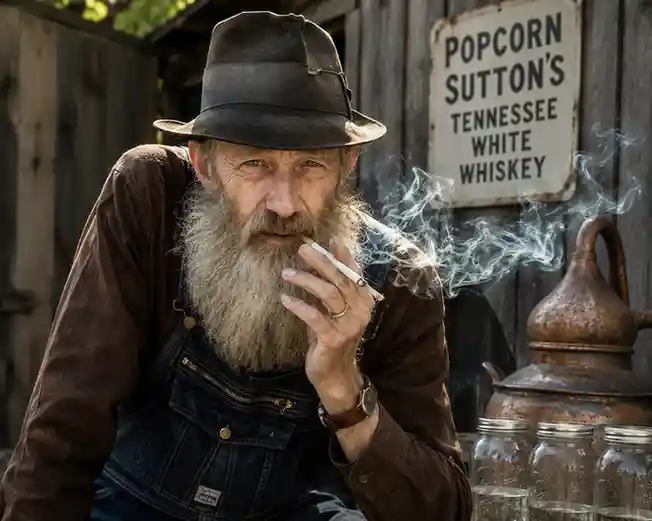
He didn’t buy his stills; he built them from scratch using scrap copper and tin. He preferred the traditional submarine pot still design because it held a consistent temperature. The look of a brand-new, shiny copper still offended him; he’d muddy it up to hide the glint from helicopters. The construction of these devices by Popcorn Sutton was an engineering feat, using hand-formed dough paste made of rye flour and water to seal the seams instead of modern silicone, which he considered toxic poison.
Confrontations With the Law and the ATF
Sutton’s life reads like a log of legal battles. His first arrest came in the 1970s, but things escalated sharply in the late 2000s. A devastating fire on his property in 2007 brought responders who discovered 850 gallons of illegal mash. His parole officer gave him a clear warning: stay away from the stuff. However, a hard-headed Popcorn Sutton ignored the threat. An undercover agent later caught him selling a loaded pistol and a videotape of himself cooking up a fresh batch, sealing his fate. <sup>2</sup>
The Documentary That Introduced Him to the World
Before his death, filmmaker Neal Hutcheson documented Sutton’s life, creating the definitive visual record of a vanishing skill set. The footage shows him wearing a long, ragged gray beard, driving a jalopy truck, and cursing like a sailor while patiently building a still. That documentary, often referred to as This is the Last Dam Run of Likker I’ll Ever Make, became a cult classic. It froze Popcorn Sutton in time, capturing a raw authenticity that reality television tries but fails to manufacture.
The Tragic End of an American Original
In 2009, the judge sentenced the 62-year-old moonshiner to 18 months in a federal penitentiary. Facing a prison term that threatened to separate him from his wife, Pam, and his mountain home, Sutton made a final, defiant decision. He parked his green Ford Fairmont by the river, connected a hose to the exhaust pipe, and ended his life via carbon monoxide poisoning. His suicide note read like a final contract: he asked to be buried next to his father, and he didn’t want a bunch of people “crying over his corpse.” <sup>3</sup> The death of Popcorn Sutton marked the end of an era, transforming a local character into a martyr for personal freedom.
Popcorn Sutton’s Moonshine Lives On Legally
Death didn’t dilute the brand. Hank Williams Jr. partnered with Sutton’s widow, Pam, to launch a legal version of the whiskey, using the exact family recipe. The distillery, located in Nashville, Tennessee, produces a clear, unaged corn liquor under the official label “Popcorn Sutton’s Tennessee White Whiskey.” The bottle, shaped like a miniature fruit jar, pays direct homage to the man who once hid these same jars under the floorboards of his cabin. A portion of the proceeds from every legal sale of Popcorn Sutton whiskey goes directly to Pam Sutton.
How Popcorn Sutton Shaped Modern Whiskey Culture
Walk into any craft distillery in America today, and you’ll feel his presence. The “grain-to-glass” movement and the popularity of “white dog” (unaged whiskey) owe a debt to his methods. Marketers have turned the “outlaw” image into a billion-dollar industry, yet none of the imitators carry the stains on their hands that he did. When modern distillers romanticize the bootlegger, they are chasing the ghost of Popcorn Sutton—a man who never tried to be cool but defined cool through sheer rebellion.
Separating the Man From the Tall Tales
Not every story about him survives the truth test. Over the years, fans have inflated him into a folk hero who never missed a shot or lost a fight. In reality, he was a complicated man who could be incredibly kind to his neighbors and absolutely ferocious to his enemies. He struggled with the modern world’s bureaucracy, not because he was unintelligent, but because he viewed rigid systems as fundamentally un-American. Understanding Popcorn Sutton requires accepting the darkness alongside the humor; you cannot romanticize the liquor without acknowledging the destructive reality of alcoholism that often shadowed the trade.
Frequently Asked Questions
What was Popcorn Sutton’s real name?
His legal birth name was Marvin Sutton. He adopted the nickname “Popcorn” after a bar fight where a pool cue made a popping sound against his head.
Where was Popcorn Sutton buried?
He was buried in a private family cemetery in the mountains of Haywood County, North Carolina, next to his father, as requested in his final note.
What proof was Popcorn Sutton’s moonshine?
His traditional corn whiskey usually ran between 130 and 140 proof. He often diluted the “hearts” down with fresh spring water to a more drinkable 100-proof for immediate consumption.
Is Popcorn Sutton’s Tennessee White Whiskey real moonshine?
It is a legally produced, sugar-shine-style whiskey based on his personal recipe. The legitimate company uses his name and methods, selling an unaged spirit that closely mimics the taste profile of his historic illegal batches.
Why was Popcorn Sutton so famous?
His fame derived from a combination of his unrehearsed personality in documentary films and his stubborn refusal to stop distilling despite decades of police raids. He represented the last link to a pre-industrial Appalachian lifestyle.
What did Popcorn Sutton say in his suicide note?
The note contained his final instructions. He professed his love for his wife, told the sheriff to have him cremated, and strictly ordered, “Don’t have a bunch of people standing around looking at me.”
A Legacy Etched in Copper
The value of a man is not measured by how quietly he followed the rules, but by what he left behind when the rules killed him. Popcorn Sutton left a recipe, a jar of white whiskey, and a legendary disregard for anything that tried to tame the wildness of the hills. He proved that a life spent doing what you love, regardless of the consequences, burns brighter than any government-issue fluorescent light. Next time you hear a banjo or smell a wood fire in the fall, pour a little out for the last of the old-timers—he wouldn’t want you to cry, but he’d sure appreciate the gesture.